
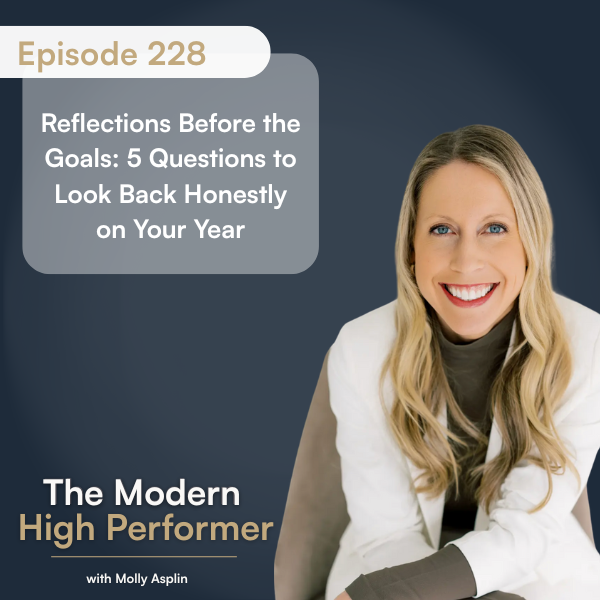
Reflections Before the Goals: An Honest Look at the Year
Thank you to Clay & Vine Interiors for sponsoring this episode. Jamie has helped us transform a couple different rooms in our home — from my office shelves to our lower level — and each project has brought more warmth, ease, and “this finally feels like us” energy into our space. She evolved our space in a way that really fits our family. Check out Clay & Vine interior design services here.
Why Reflection Must Come Before Goal Setting
The Hidden Cost of Rushing Into the New Year
The fastest way to burn out in the new year is trying to plan your entire year at once. The moment the holidays end, the pressure ramps up — reflect on the year, set goals, decide who you’re becoming, map out the next 12 months.
Meanwhile, you’re still putting away decorations, wrapping up work, and trying to catch your breath. If you’re feeling overwhelmed, you’re not behind — and you’re not doing it wrong.
The problem isn’t you. It’s the way we’ve been taught to approach goal setting.
High performers typically don’t need more motivation. They need clarity, direction, and a framework that actually works with real life, not against it.
Five Reflection Prompts to Ask Before Setting Goals
Reflection Creates Clarity — Not Pressure
Before you think about goals, pause and reflect honestly. These five prompts are the foundation of this episode, and I strongly encourage you to write them down and spend time with them:
- What looked “good,” but didn’t feel good?
- What was the hardest part of your year — and what did you learn from it?
- Where do you need to stop comparing or performing?
- Who did you let see the real version of you this year?
- What permission do you need to give yourself before you set goals for the new year?
Reflection gives context. It helps you stop repeating patterns, tolerating misalignment, or setting goals based on external expectations instead of internal alignment.
Prompt #1: What Looked “Good” — But Didn’t Feel Good
This is the high performer question — because we’re really good at making life look fine.
Something can look aligned, successful, responsible, even admirable… and still feel heavy, draining, anxious, or resentful behind the scenes.
For me this showed up with Fridays with my kids. For years, it worked and it felt right. But halfway through this past year, I started feeling frazzled, reactive, and resentful. Not because I don’t love my kids — but because the structure stopped fitting the season I’m in. My expectations were too high and how I was trying to go about it no longer felt right. So, I decided to make a change that will happen in the fall and get Friday care for my kids.
I realized I needed more margin — to close work loops, run errands, take care of myself, and stop trying to wrap up every tiny thing before weekend while also being mom.
Sub-questions to help you go deeper
- Where are you technically doing the thing… but it’s costing you more than you want to admit?
- What are you doing because it once worked — but doesn’t fit anymore?
- What are you silently tolerating because it looks good on paper?
Examples that might resonate:
- Hosting big events because you can… but you don’t even like hosting
- A flexible job that looks ideal… but it keeps you playing small and doesn’t feel meaningful
- Kids’ activities that look “full and fun”… but your family pace feels too fast
- A career that looks successful… but feels boring, flat, or disconnected
Sometimes the win isn’t pushing through.
Sometimes the win is giving yourself permission to evolve.
Prompt #2: What Was the Hardest Part of Your Year — And What Did It Quietly Change About You?
This usually isn’t one single moment. It’s a theme. A recurring feeling. A pattern.
And one of the best ways to uncover it is simply scrolling through your photos — because you’ll remember the emotion underneath the moment.
For me, the hardest part of the year wasn’t logistical. It was internal.
I underestimated the identity shift that came with a major career change — the unraveling of external validation, the renegotiation of roles at home, and the messy ambiguity of building momentum in a new chapter.
It forced me to face a real question:
If no one can see my progress or achievements… do I respect who I’m being?
That’s what this reflection prompt is here for — to attach meaning and learn what the hard parts taught you.
Sub-questions to help you go deeper
- What felt hardest internally, not just in your calendar?
- What did this year require you to release, redefine, or rebuild?
- What did the hard part teach you about what matters — and what doesn’t?
Prompt #3: Where Do You Need to Stop Comparing or Performing?
Comparison is sneaky because it often hides as “inspiration.”
You see good people living beautiful lives — travel, experiences, milestones, highlight reels — and you start measuring yourself against a standard that isn’t even real life.
This year I got honest about how often I was subconsciously asking:
“Should our life look like that?”
And the better question became:
“Do I actually want that… or do I just think I’m supposed to?”
Because just because something is popular (or all over your algorithm) doesn’t mean it’s aligned.
I don’t want a life that looks amazing on a screen if it leaves me feeling disconnected, exhausted, and behind.
I want a life that feels like mine.
Sub-questions to help you go deeper
- What expectations have you adopted that aren’t even yours?
- Where are you performing instead of choosing?
- What would your life look like if you only followed your values — not the noise?
Sometimes the reflection isn’t “do more.”
Sometimes it’s acceptance — surrendering to the season you’re actually in.
Prompt #4: Who Did You Let See the Real Version of You This Year?
This is the one that surprised me the most.
Because when I slowed down the comparison and performance… I stopped carrying everything alone.
This year, I let people in.
I cried with friends. I said the hard things out loud. I made the “Hey, do you have a minute?” calls. I asked people who have gone before me, “Am I alone in this season?”
And I also held space for others — and it’s wild how vulnerability works:
When you go first, you give other people permission to be real too.
Connection did more for me than productivity ever could.
Sub-questions to help you go deeper
- Who did you let see you — not the polished version, the real version?
- Where have you been strong… but alone?
- Where do you need more support, community, or honest conversation?
And if this isn’t something you’ve done much of this year:
Who might need that from you next year?
Who could use your steadiness, your presence, your voice?
Prompt #5: What Permission Do You Need to Give Yourself Before You Set Goals?
Before we talk goals, we have to talk permission.
Permission to change.
Permission to stop proving.
Permission to set boundaries that actually match your life.
Permission to evolve — even if the past version of you was successful.
Maybe it’s permission to:
- stop working at a certain time
- build in real margin instead of sprinting until collapse
- go screen-free on Sundays
- address the thing you’ve been avoiding (marriage, health, fulfillment, rest)
- accept the season you’re in — without shame
One resource I mentioned that deeply supports this idea is Personality Isn’t Permanent by Dr. Benjamin Hardy — because so much of what we tell ourselves (“this is just who I am”) is, indeed, changeable.
Sub-questions to help you go deeper
- What do I need to release before I add anything new?
- What boundary would instantly make next year feel lighter?
- What permission am I waiting for that I can give myself now?
Closing Reminder
This episode isn’t about fixing you.
It’s about telling the truth — and letting the truth reveal what’s been misaligned, what needs to evolve, and what you’re ready to carry forward.
Because clarity doesn’t come from pushing harder.
It comes from being honest about what this season is asking of you.
In the next episode, we’ll talk about goal setting — but from a tried and true exercise that will give you real momentum. I learned it years ago, and it is powerful.
Until then: take a breath, put a hand on your heart, and remember that releasing is productive too.
Enjoyed this episode? Here are a few ways to stay connected:
If today’s conversation resonated, share it with a friend, teammate, or leader who’s ready to lead differently. That’s how we grow modern, high-performing leaders and teams.
1.) Share the episode: Hit the share button and text it to someone who would benefit.
2.) Subscribe for weekly tips: Get my short, practical insights delivered every week to your inbox—perfect for your workday, your home life, or even to kick off a team meeting. Subscribe here.
3.) Leave a rating and review: If you’re loving the show, a quick review helps more people discover these conversations (and it means a lot).
Thanks for being part of the movement toward a more human, high-performing world.