
Thank you to Nourish Move Love for sponsoring this episode.
I’ve shared this before, but Nourish Move Love workouts are some of my favorites — efficient, smart, and challenging in the best way. Athlete25 has become one of my favorites – I love the mix of strength, mobility, and cardio all wrapped up into one workout. It makes you feel strong, energized, and clear-headed in just 25 minutes a day.
If you’re looking for a simple, effective strength routine that fits into real life, Athlete25 is a great option. It’s designed for busy, high-performing women who want results without spending hours working out.
Click here to get the free workouts delivered straight to your inbox.
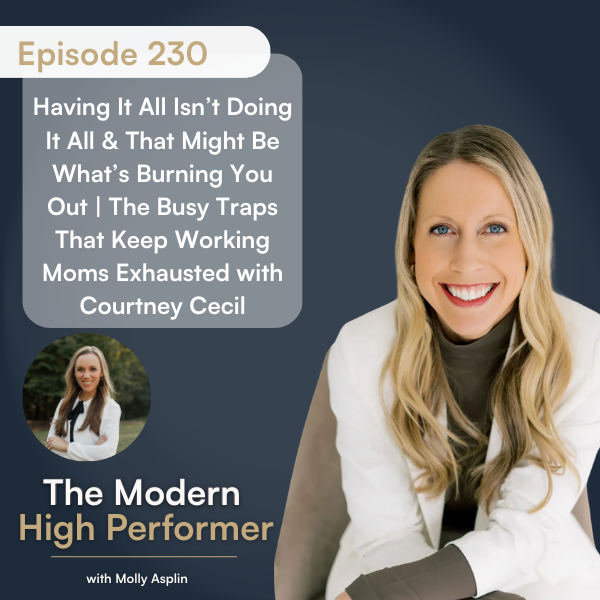
The Busy Traps That Keep Working Moms Exhausted with Courtney Cecil
If you’re a working mom who’s ever thought, Why does it feel like I’m failing at everything even though I’m doing everything? — this episode is for you.
Today’s conversation is one I wish every high-performing working mom could hear. I’m joined by Courtney Cecil, founder of Working Moms Movement, former Fortune 50 Head of Culture, and an industrial and systems engineer by training. In other words, she understands systems, efficiency, leadership — and exactly why so many working moms feel maxed out, burned out, and stuck in constant “go mode.”
This episode challenges the belief that having it all means doing it all — and unpacks why that mindset may be the very thing keeping you exhausted.
Why Working Moms Feel Burned Out Even When They’re “Doing Everything”
You’re Not Bad at Balance — You’re Operating in a System that Rewards Overworking
One of the most important truths Courtney shares is this: most working moms aren’t doing life wrong — they’re operating inside a system that rewards overgiving.
We’re praised for being available, flexible, dependable, and self-sacrificing — until it breaks us. Over time, this leads to exhaustion, resentment, and a quiet loss of identity.
Courtney calls this giving yourself away for free — pouring your time, energy, and emotional labor into work and home without boundaries or sustainability.
Courtney’s Turning Point: Burnout, Loyalty, and a Wake-Up Call
When Sacrificing Yourself Becomes A Wake-Up Call
Courtney spent 16 years in corporate leadership, ultimately serving as Chief of Staff to a CEO. She worked 80-hour weeks, pushed through illness and family strain, and believed loyalty would be rewarded.
Then she was laid off.
That moment became a defining turning point — not just in her career, but in how she views performance, boundaries, and leadership. The lesson? You can be a high performer without sacrificing yourself in the process.
The Busy Traps That Keep Working Moms Exhausted
Why “I Could Be Doing More” Is a Dangerous Thought
One of the most powerful parts of this conversation is Courtney’s breakdown of busy traps, especially for high-achieving women:
- Overfilling your calendar because there’s “space”
- Saying yes to projects out of guilt or fear
- Comparing yourself to unrealistic standards (online or generational)
- Believing rest must be earned
- Doing tasks simply because you can, not because they matter
The result? Constant motion with very little fulfillment.
Having It All Isn’t Doing It All
Values, Tradeoffs, and Letting Go of Comparison
Courtney explains this beautifully: you can have it all — but only if you define what “all” actually means to you.
Every priority creates tradeoffs. Not everything can matter equally.
When you’re clear on your values, decisions get simpler:
- What deserves your time?
- What can be delegated?
- What doesn’t actually matter — even if it looks good externally?
Trying to meet everyone else’s standards is a guaranteed path to burnout.
Outsourcing Isn’t a Luxury — It’s a Leadership Strategy
Time Is Your Most Valuable Resource
One of the most practical parts of this episode is our conversation about support systems.
Courtney reframes outsourcing as a necessity, not a luxury — especially in what she calls the squeeze: the season where careers, family needs, and financial pressure all peak at once.
She shares why tools like a house manager can actually reduce mental load more effectively than traditional help — because they remove the constant day-to-day friction, not just occasional tasks.
The takeaway: protect your time like the strategic asset it is.
Why Most Boundaries Fail (and How to Make Them Stick)
Naming the Boundary Isn’t Enough
We also dig deep into boundaries — and why so many don’t work.
Boundaries fail when:
- They aren’t clearly defined
- There’s no emotional reason behind them
- There are no systems to support them
Boundaries that stick are tied directly to values and reinforced with practical controls — like tech limits, routines, or structural changes.
What Leaders and Organizations Are Missing
Trust, Control, and Burnout Prevention
From Courtney’s years leading culture inside Fortune 50 organizations, she shares a critical insight: companies focus too much on performance skills and not enough on whether people feel in control of their lives.
When employees don’t feel supported at home, they can’t fully engage at work.
Trust — not policing — is the foundation of sustainable performance.
Final Takeaway for Working Moms
You don’t need to do more.
You don’t need to try harder.
You don’t need better time management.
You need alignment.
When your values, priorities, boundaries, and support systems work together, high performance at work stops feeling like survival — and starts feeling sustainable.
How to Connect with Courtney Cecil
You can find Courtney and her work here:
- Instagram: @workingmomsmovement
- Podcast: Life Management System (available wherever you listen)
If this episode resonated, share it with a working mom who needs permission to stop doing it all — and start building a life that actually works.
Enjoyed this episode? Here are a few ways to stay connected:
If today’s conversation resonated, share it with a friend, teammate, or leader who’s ready to lead differently. That’s how we grow modern, high-performing leaders and teams.
1.) Share the episode: Hit the share button and text it to someone who would benefit.
2.) Subscribe for weekly tips: Get my short, practical insights delivered every week to your inbox—perfect for your workday, your home life, or even to kick off a team meeting. Subscribe here.
3.) Leave a rating and review: If you’re loving the show, a quick review helps more people discover these conversations (and it means a lot).
Thanks for being part of the movement toward a more human, high-performing world.